
A 30-day boxing challenge for people over 35 who aren't trying to get ripped. They're trying to stop feeling dead by lunch. 100 people doing it together.
15 minutes of movement before the laptop opens. The outcome isn't a body transformation. The outcome is: you have energy left when your kid wants to play at 6pm.
Larry — our punk dog mascot — has one rule: Show it done badly. Your worst attempt is more valuable than their best highlight reel.
Your day, honestly
You know the feeling. You've been knowing it for years now.
The alarm goes off at 7am. You're not rested. You slept 7 hours but it felt like 3. Your body is horizontal but your mind already went through tomorrow's standup, last night's argument, and the EMI that's due on the 5th. You get up because the alarm won't stop. Not because you feel ready.
By 10am you hit your window. This is your good hour. Your one good hour. You send the emails, you make the decisions, you feel almost like a functional human being for 90 minutes. This is the version of you that got the job, got the promotion, convinced someone to marry you. This version shows up for about an hour and a half per day. Then it leaves.
By 12:30 you're hungry but not really hungry — more like your body needs something, anything, to break the monotony. You eat too much at lunch because the dal chawal is there and you deserve it and also you're stress-eating but calling it “lunch.”
2pm. Dead. Coffee number two. Eyelids heavy. You're staring at Slack but nothing is registering. You open a doc, read the same paragraph three times, then switch to Twitter. You're billing hours but producing nothing. Your brain is running on fumes and the afternoon has barely started.
5pm. You're done. Not “done with work” — done as a person. Your kid runs up. “Baba, let's play!” And you negotiate. Not because you don't want to. Because your body has nothing left to give. “Later.” “Tomorrow.” “Baba is tired.”
Later never comes. Tomorrow is the same. Your kid learns to stop asking. That's the part that should scare you more than your cholesterol numbers.
By 8pm you're on the couch. Phone in hand. Scrolling reels. Too tired to do anything meaningful, too wired to fall asleep. You'll lie in bed until 11:30, finally drift off, and wake up at 7am feeling like you didn't sleep at all. And do it again.
This has been your day for 3 years. Maybe 5. Maybe longer.
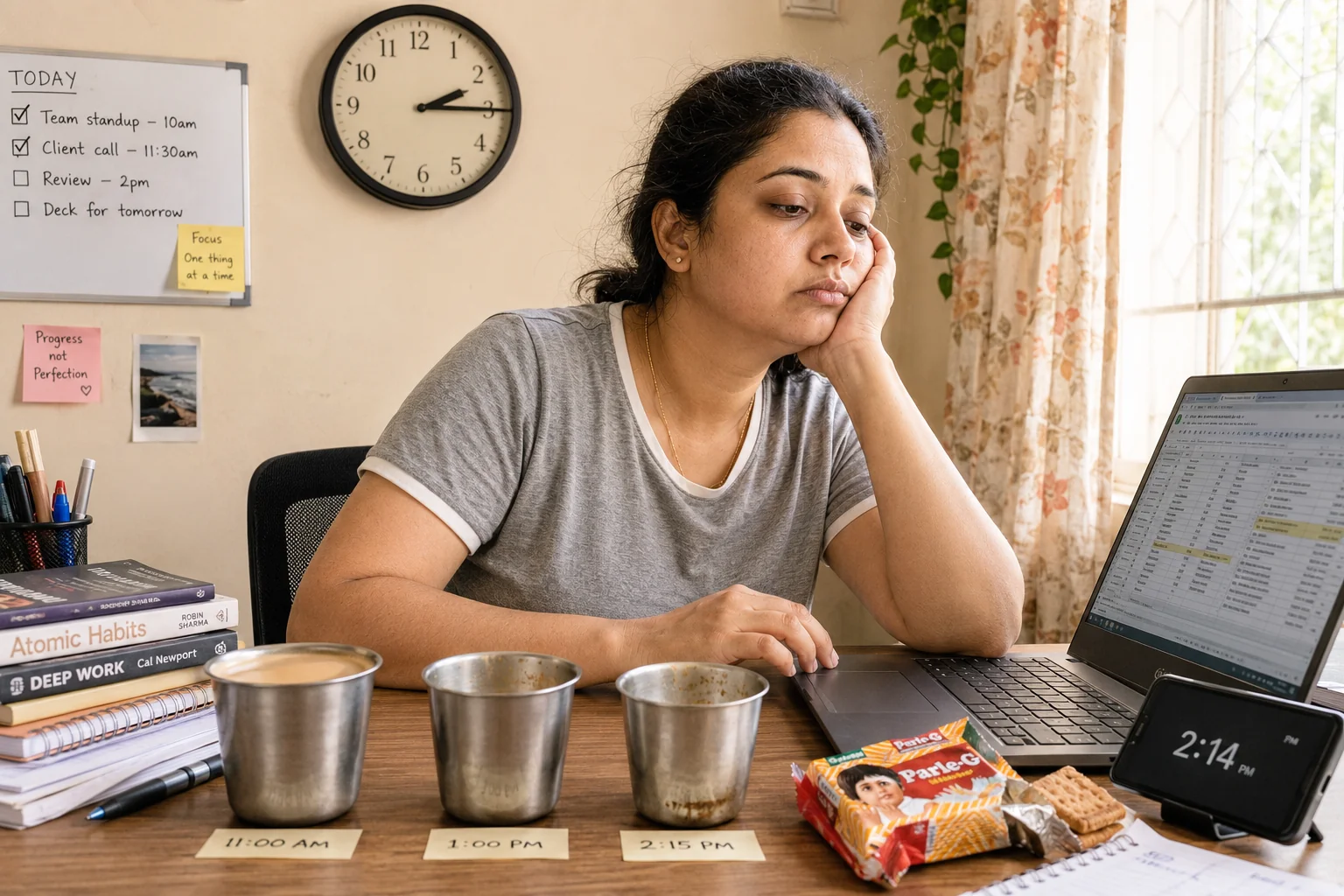
Here's what nobody tells you about this pattern: it's not the work. It's not the stress. It's not your age, or your thyroid, or your sleep quality — though all of those matter.
It's the not-moving.
Your body is a machine that was designed to move 4-6 hours a day. Hunt, gather, walk, carry, climb. For 200,000 years of human evolution, that's what it did. Now it sits in a chair for 10 hours and you're surprised it doesn't work properly.
A car that sits in a garage for 3 years doesn't start well. Your body is the same. The lethargy isn't a mystery. It's the predictable consequence of asking a movement machine to be still for a decade.
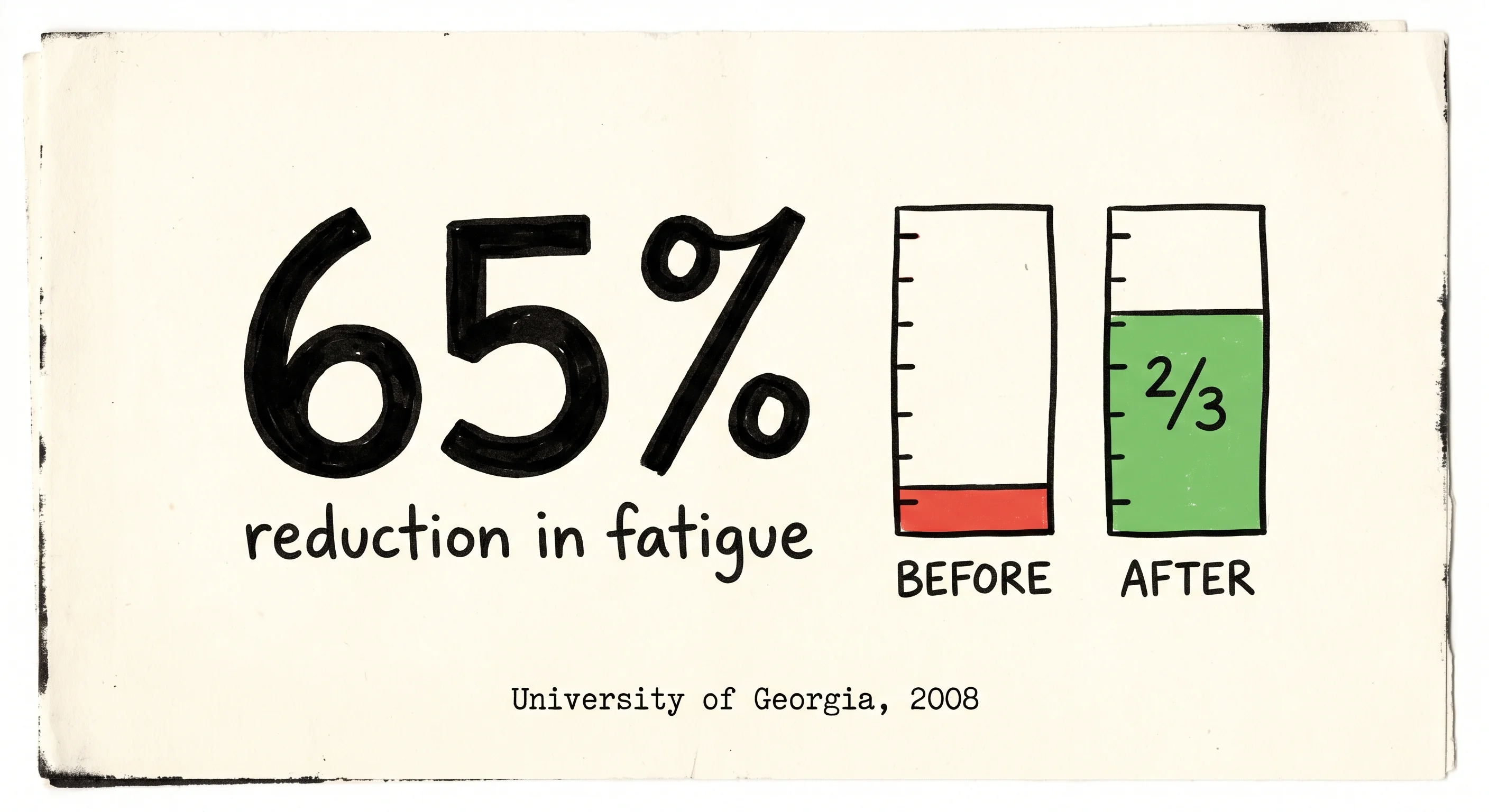
That number is from a peer-reviewed study, not an Instagram infographic. 20 minutes of low-intensity exercise. Not HIIT. Not CrossFit. Not running 10K. Low intensity. Moving your body in a way that raises your heart rate slightly and makes your muscles remember they exist.
The researchers were surprised by their own findings. They expected high-intensity exercise to win. It didn't. The low-intensity group — the people doing what amounts to “moving around a bit” — saw the biggest drop in fatigue. Your body doesn't need to be punished. It needs to be woken up.
The intervention
First Jab is a 30-day boxing program you do at home. No gym. No equipment. No coordination required. 5 rounds, 2 minutes each, about 22 minutes before your workday starts.
Every day, you get one boxing movement. Jab. Cross. Hook. Uppercut. Guard hold. Footwork. You do the movement. You film yourself doing it. You post it. Then you get on with your day.
The boxing itself is not the point. The point is what happens to the other 15 hours and 45 minutes of your day after those 15 minutes.
What if the 5pm version of you had something left?
That's the entire pitch. Not a six-pack. Not weight loss. Not “getting fit.” Just: what if you weren't running on empty by early afternoon? What if you could play with your kid at 6pm and not feel like you were borrowing energy from tomorrow?
Here's why boxing movements specifically do this better than a morning walk or a few push-ups:
Full-body activation
A jab starts in your feet, travels through your hips, and ends in your fist. Every punch is a full kinetic chain. Your body wakes up from toes to fingertips. Not just legs (walking) or just arms (push-ups) — everything.
Cardiovascular without cardio
3 minutes of shadow boxing raises your heart rate to 130-150 BPM. That's a 20-minute jog compressed into a fraction of the time. Your heart and lungs get trained without the time commitment of running.
Neurological engagement
Boxing requires coordination, timing, and spatial awareness. Your brain has to work alongside your body. This dual engagement releases more BDNF (brain-derived neurotrophic factor) than simple repetitive exercise. Translation: sharper focus that lasts hours.
Stress discharge
Punching air for 15 minutes releases the cortisol your body has been stockpiling. That tension in your shoulders, your jaw, your neck — boxing burns through it physically. The 2pm crash is partly a cortisol crash. Discharge it in the morning and the afternoon is different.
The morning walk is fine. Nobody's arguing with a morning walk. But a morning walk doesn't wake up your shoulders, your core, your hips, or your brain. It wakes up your legs and your podcast habit.
Boxing movements are a full-body ignition. 15 minutes. Everything fires. The rest of the day runs on the momentum.
The real diagnosis
You think you're exhausted because your job is demanding. And your job is demanding. But construction workers work harder and have more energy at 5pm than you do. Auto-rickshaw drivers are on their feet in 42-degree heat for 12 hours and still have the capacity to argue about politics at 9pm.
The difference isn't willpower. It's movement. Their bodies move all day. Yours doesn't. Your body interprets stillness as shutdown. It conserves energy because, as far as it knows, you're hibernating. Your metabolism slows. Your circulation drops. Your muscles atrophy. Your brain gets less oxygen.
And then you wonder why you're tired.
You're not tired from working too much. You're tired from moving too little. Your body has been in power-saving mode for years.
The fix isn't rest. You've tried rest. You took that Goa trip, slept 10 hours a night for a week, and felt great for exactly 2 days after coming back. Then the pattern returned. Because rest is the treatment. Movement is the cure.
Not movement like marathon training. Not movement like a gym membership you'll use for 3 weeks. Movement like: 15 minutes, before the laptop opens, your body does something that makes your heart rate go up and your muscles remember they exist.
That's what First Jab is. Not a fitness program. An energy intervention that uses boxing movements as the format.
100 spots · ₹699/mo
Join First Jab →The part that actually works
You don't need more information. You've read the articles about morning exercise. You know movement helps. You have 3 fitness apps on your phone gathering dust. You've watched enough YouTube to coach yourself. Information is not your problem.
The problem is Tuesday. The problem is the alarm goes off and it's cold and the bed is warm and nobody will know if you skip. The problem is Thursday, when you skipped Tuesday and Wednesday and the guilt has already turned into “I'll start fresh next week.” The problem is being alone with your intention.
First Jab fixes this by making your attempt visible. Show it done badly. Larry doesn't care about your form, your lighting, or your gear. He just wants to see you try.
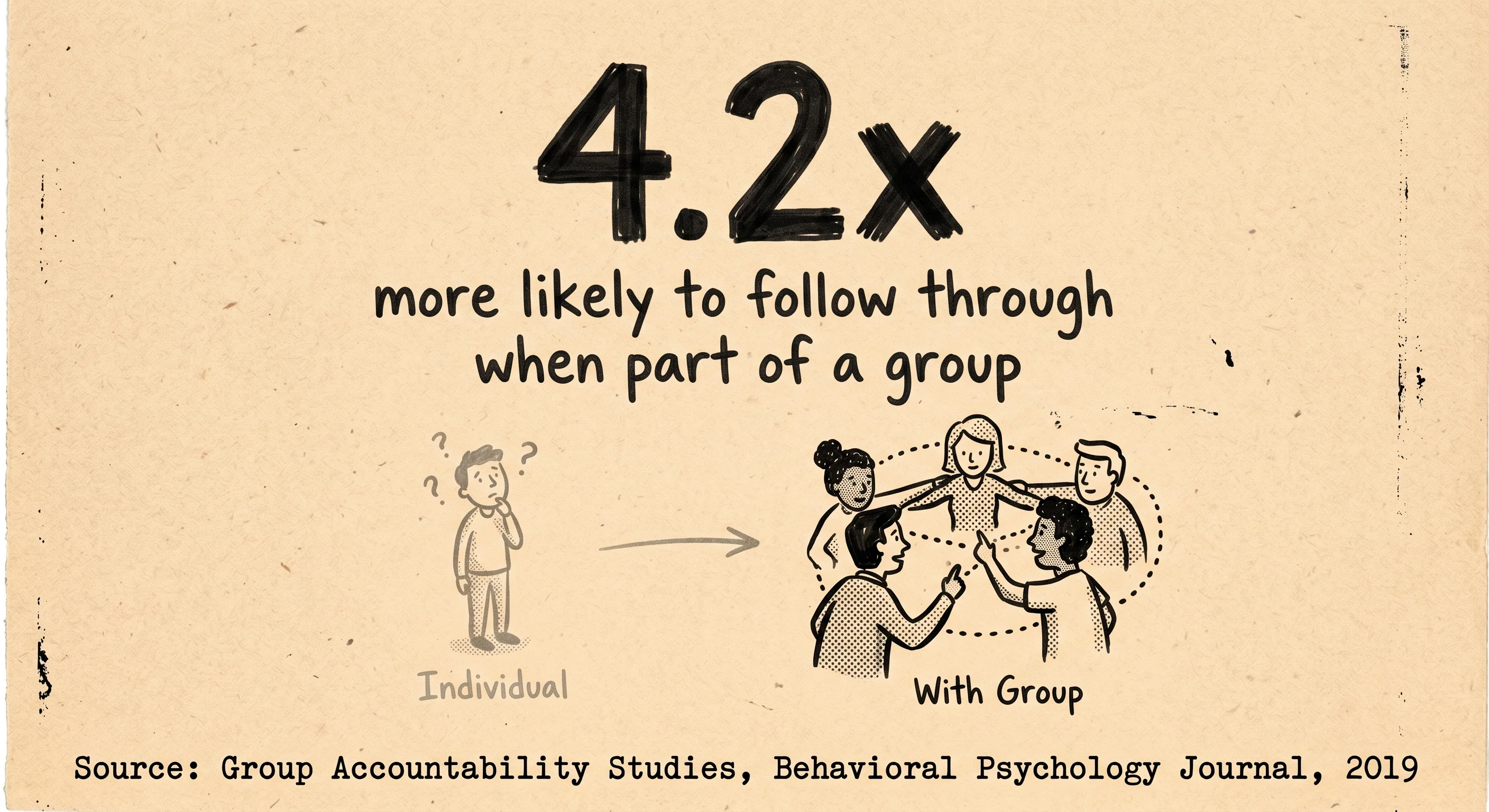
Every day, you film yourself doing the movement and post it. 99 other people — all over 35, all starting from the same depleted place — do the same. When you post, you see everyone else's attempts. When you skip, the gap is visible. Not to the internet. To 99 people who are doing this with you.
The person who held their guard for 12 seconds before their arms collapsed? They posted it. The guy who threw a cross and accidentally hit his own chin? He posted it. The woman in Chennai whose hook looked like she was hailing an auto? She posted it.
Nobody is performing. Nobody is good at this. Everyone is tired and stiff and showing up anyway. That's the whole point — doing it badly IS the point. And that showing up — that daily proof that 99 other exhausted people are choosing 15 minutes of movement over 15 more minutes in bed — is what pulls you back on the days when motivation fails.
Motivation fails constantly. Community doesn't.
Everything you've tried
The morning walk you tried in 2023 — lasted 11 days. The gym membership in 2022 — used it 8 times in 3 months. The home workout app — deleted after the free trial. The running phase that ended when your knee started talking. The yoga class your wife signed you both up for — you went twice and said your schedule changed.
None of them failed because they were bad ideas. They failed because you did them alone. No witness. No consequence for skipping. No one doing it alongside you.
First Jab is not a better workout. It's the same workout with 99 witnesses.
The timeline
You'll feel more tired, not less. Your body isn't used to this. Your shoulders will ache. Your arms will give out holding a guard after 15 seconds. You'll wonder if this is making things worse. It's not. Your body is recalibrating. The engine is sputtering back to life.
Somewhere around Day 5, you'll notice something small. The 2pm crash is still there but it's less of a wall and more of a dip. You'll make it to 3pm before reaching for the coffee. It's subtle. Don't ignore it — that's your metabolism remembering what it's supposed to do.
Your sleep changes first. You'll fall asleep faster. Not because you're exhausted — because your body is actually physically tired in the way it's supposed to be. The kind of tired that produces sleep, not the kind that produces insomnia. Morning grogginess starts shrinking.
The 2pm crash is now a 3pm dip. Your productive window stretches. People at work might notice — 'you seem more awake in the afternoon.' Your kid asks to play at 6pm and you don't negotiate. You just play. You don't notice this in the moment. You notice it when someone points it out.
Energy after 5pm is normal now. Not boundless — normal. The way it used to be before 10 years of sitting. You sleep better. You wake up easier. Your back pain is quieter. And the 15 minutes of morning movement isn't a chore anymore. It's the thing that makes the rest of the day work.
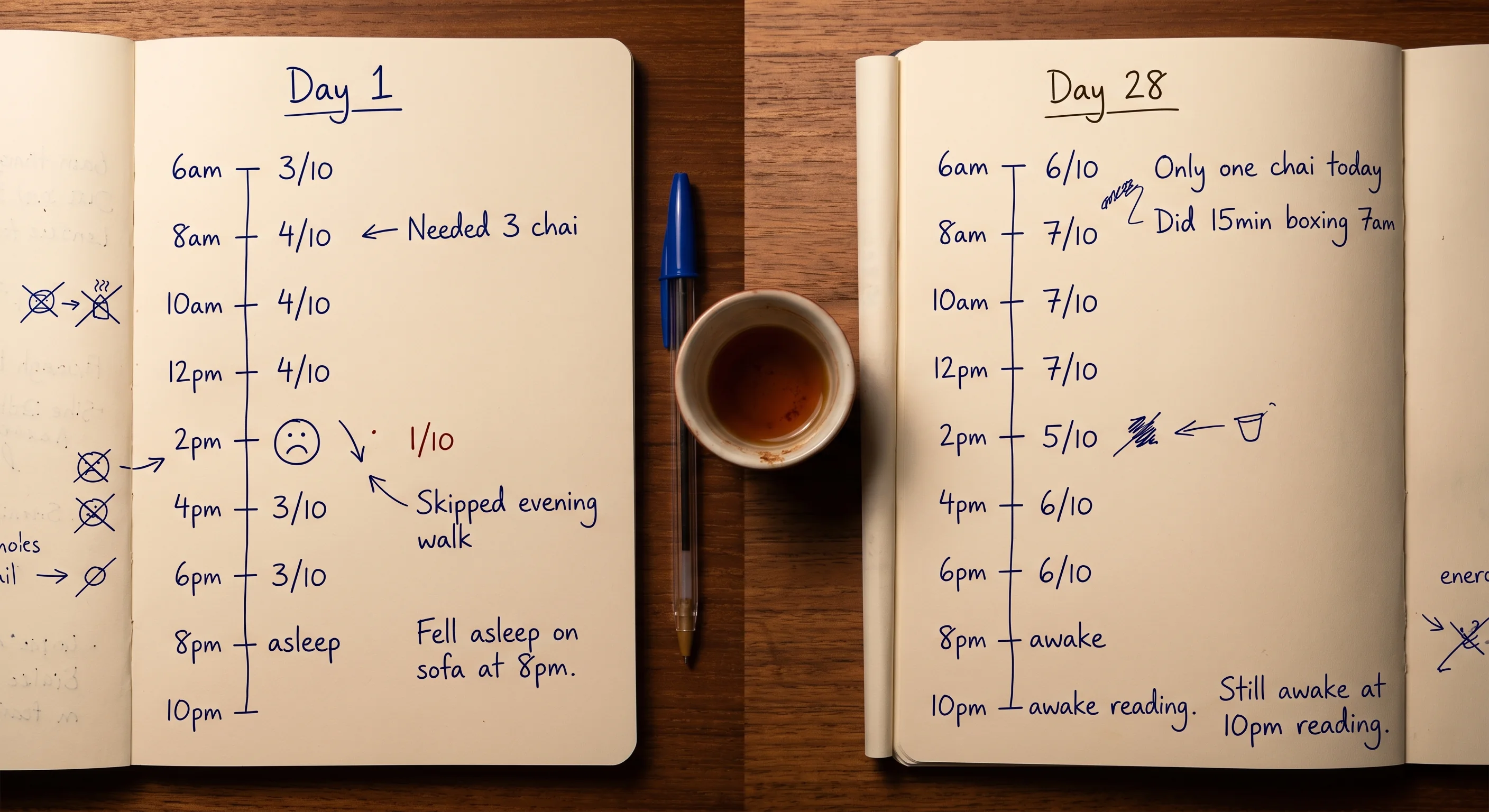
The change you feel is bigger than the change you see.
From the room
Day 12, my daughter asked me to play badminton after dinner. Normally I'd say 'tomorrow, papa is tired.' I said yes without thinking. We played for 40 minutes. That's when I realised — the 7am jab-cross routine was doing something I couldn't see on a scale. My 4pm energy used to be zero. Now it's not amazing, but it's enough. Enough to be present.
Raghav N.
38, Bangalore — startup founder
I used to have three coffees before 3pm. Not because I love coffee — because I literally couldn't keep my eyes open in client calls after lunch. Two weeks of morning guard holds and 1-2 combos, and I'm down to one coffee. My 2:30 meeting yesterday? I actually had opinions. My manager probably thinks I got promoted somewhere else. No, I just threw punches at 6:45am.
Anita B.
41, Pune — senior consultant
I've been a terrible sleeper for years. Scrolling till 1am, dragging myself out of bed at 9, starting work already exhausted. Around Day 10 of doing the morning stance and shadow boxing routine, I noticed I was falling asleep by 11:30. Not trying to — just... sleepy. Waking up at 6:40 without hating everything. It's embarrassing that 15 minutes of throwing jabs fixed what melatonin couldn't.
Siddharth G.
36, Mumbai — backend developer
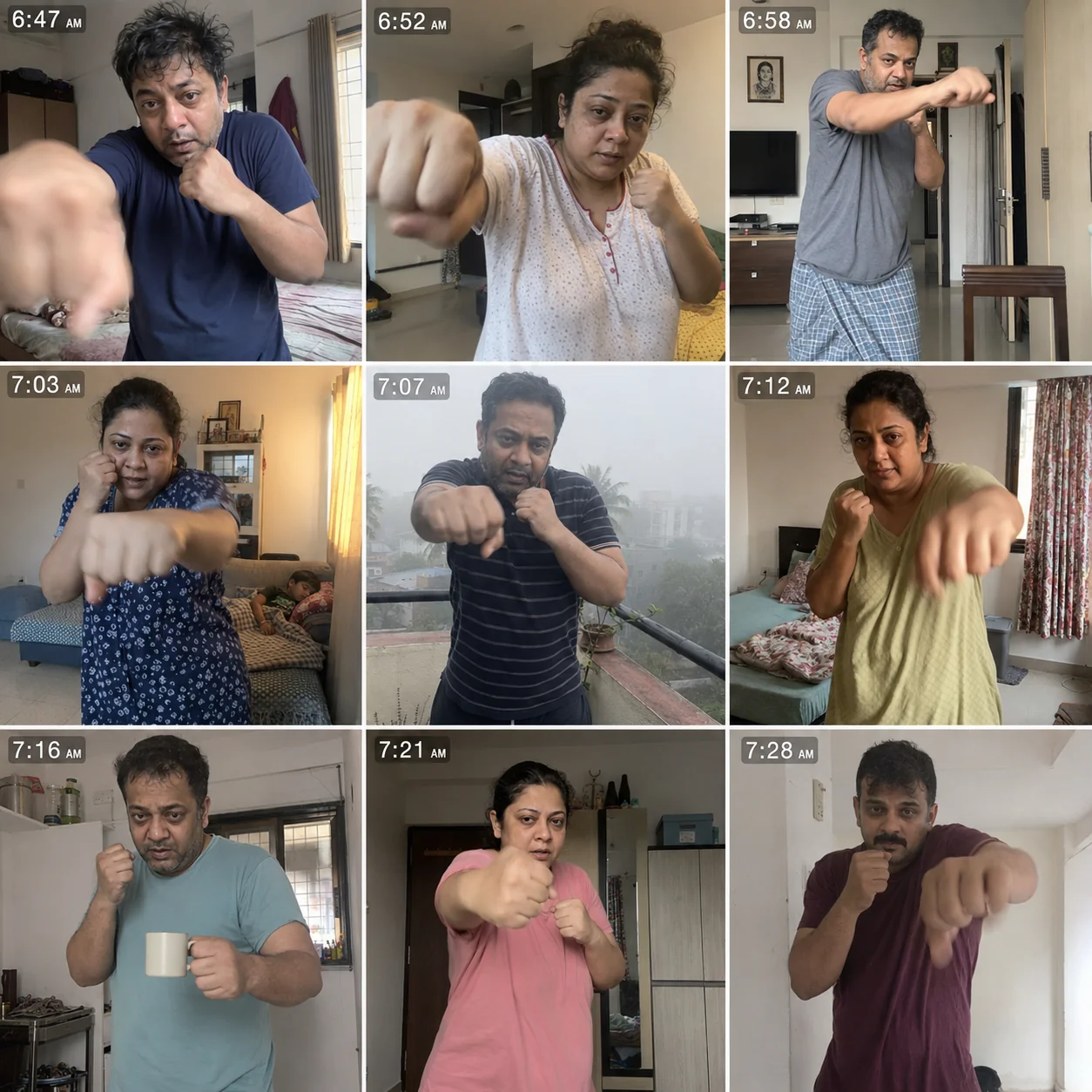
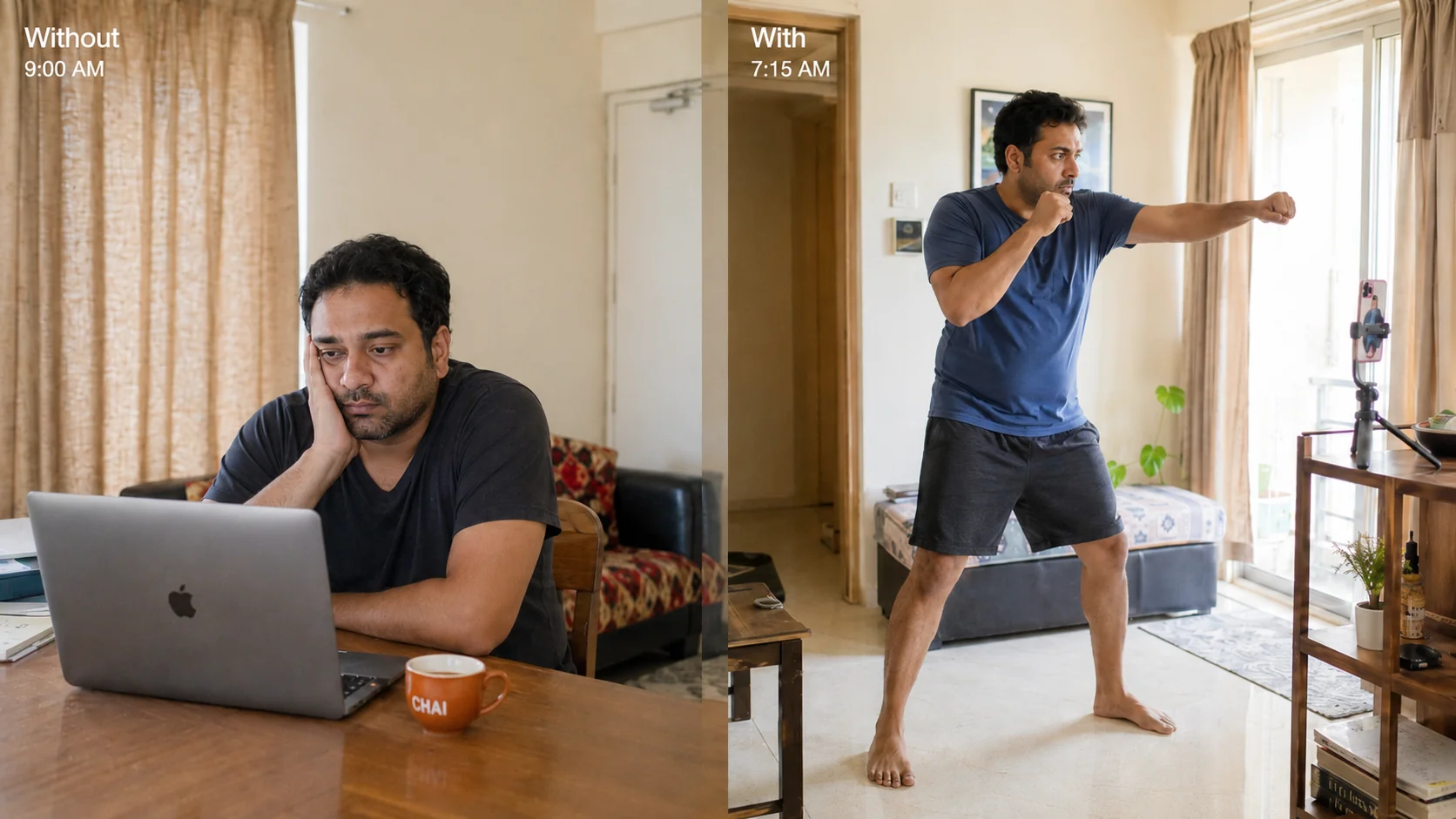
This is what 7:15am looks like for 100 people who used to skip straight to the laptop.
The daily loop
1
Join the room
Sign up. Your seat is yours from day one. Premium gives you access to all communities and every challenge. Cancel anytime — no lock-in.
2
Watch the day's movement
Every day, Vinay posts a short video teaching one boxing movement. Day 1 is orthodox stance + jab. Day 6 is hooks. Day 19 is bob and weave. Each lesson breaks the movement into rounds — 5 rounds × 2 minutes with 1-minute rest. About 22 minutes total. Clear instructions for people who've never thrown a punch.
3
Film your attempt
Do the movement. Film yourself. Post it in the community. Your form will be bad. Your timing will be off. Your face will look confused. That's the point. That's step one.
4
See everyone else's
Once you post your attempt, you unlock the community feed. See how badly everyone else started. Watch 40-year-olds throw terrible jabs. Feel the relief of realising you're not the worst. Or maybe you are. Either way, you posted.
5
Show up tomorrow
Repeat. Day after day. The movement gets slightly harder, but your body gets slightly better. By Day 7 you're throwing a 1-2 combo. By Day 15 you're slipping punches. By Day 30, you'll do a full 5-round simulation and your body will be a different machine.
₹23/day · Less than your second coffee
Join First Jab — ₹699/mo →Your host

This is what Day 240 looks like. Still not great. Still here.
I'm 38. I started boxing because I was tired of feeling 55. I sit at a desk most of the day. My back hurt every morning. My shoulders rounded forward. I used to be active and then life happened and I stopped.
I started doing boxing movements at home. 15-20 minutes a day. Not to become a boxer — to undo what my desk was doing to me. And it worked. Not dramatically. I'm not posting before-after photos. But my back doesn't hurt when I wake up. I can play with my kids without being winded. I stand straighter without thinking about it.
My kid said “baba you're fast now” and I almost cried. None of this is remarkable. Remarkable is what fitness Instagram sells. I'm selling 15 minutes of mediocre movement that quietly changes how your body works.
I built First Jab because I was tired of being tired. Not injured-tired. Not sick-tired. Just the low-grade, constant, soul-draining exhaustion of a body that sits in a chair for 10 hours and then wonders why it has nothing left. 5 rounds of boxing in the morning — about 22 minutes — changed the other 15 hours. I wanted 99 other people to find out the same thing.
I'm in the community with you. I post my attempts daily. I'm in the chat. I watch submissions. This isn't a course you buy and get abandoned in — I'm doing the program alongside you.
Based in Bangalore · Running this from my living room
The voice in your head
“Will boxing actually help with energy? Sounds like bro science.”
It's not boxing-specific. It's movement-specific. Any form of morning exercise that elevates your heart rate, engages multiple muscle groups, and requires coordination will improve your energy baseline. Boxing movements happen to do all three efficiently in 15 minutes with zero equipment. The University of Georgia study found a 23% fatigue reduction from low-intensity exercise. The American Heart Association recommends 150 minutes per week of moderate activity for exactly this reason. We're not inventing science. We're applying it.
“I'm not trying to lose weight. Is this still for me?”
Good, because this isn't a weight loss program. Nobody here is counting calories or measuring waists. The metric is: do you have energy left at 5pm? Can you play with your kid without negotiating? Does the afternoon feel like a wall or a slight dip? If weight changes happen, they're a side effect. They're not the goal and we don't track them.
“I just need more sleep. That's the real problem.”
Maybe. But consider: you've had weekends where you slept 9 hours and still felt sluggish by 2pm. You've had vacations where you rested for a week and the tiredness came back in 2 days. Sleep quality matters more than sleep quantity — and nothing improves sleep quality like physical exertion. Most members report falling asleep faster and waking up less groggy within the first 10 days. The movement improves the sleep. The sleep improves the energy. It's a loop, and movement is the entry point.
“~22 minutes can't actually make a difference.”
It's 5 rounds of 2 minutes with rest between — about 22 minutes total. 2 minutes of shadow boxing gets your heart rate to 130-150 BPM. Multiply that by 5 rounds. Your cardiovascular system doesn't care about your opinion on whether that's “enough.” It responds to stimulus. 22 minutes of elevated heart rate + full-body engagement + coordination demand is more stimulus than your body has gotten on any given Tuesday for the past 5 years. The bar isn't “optimal.” The bar is “more than zero.” And the gap between zero and 22 minutes is the biggest gap in fitness.
“I'll be too tired to exercise in the morning.”
You will be. On Day 1. And Day 2. By Day 4 or 5, you'll notice something: you're less tired after the movement than before it. That sounds wrong but it's how physiology works. Movement generates energy. Stillness depletes it. Your body is currently optimised for stillness. It takes about a week to start shifting. The community helps you survive that week.
“₹699/mo for something I can do on YouTube?”
You can shadow box watching YouTube for free. You've been able to do that for years. Have you? The difference is not the content. The difference is 99 people doing it at the same time, posting their attempts, seeing yours, noticing when you skip. You're not paying for boxing instruction. You're paying for a room where skipping feels awkward. That room is the product.
Not ready to commit?
Get 3 boxing challenges sent to your inbox. Try them at home. No payment, no commitment — just see if this is for you.
No spam. Unsubscribe anytime.
Investment
Most members start with 30 days. By Day 15, when the afternoon energy shift is noticeable, they wish they'd started with 60 or 90.
$19.99
$9.99
/month · cancel anytime
Subscription · Cancel anytime via Stripe
Secure payment via Stripe · Cards accepted
You pay ₹699/mo. You do it for a week. Your 2pm crash is slightly less terrible. You stop. You cancel. That's it.
But here's what actually happens: by Day 7, you've posted 7 videos. You've seen 99 other people post theirs. Someone commented on your Day 3 cross. You commented on someone's guard hold. There's a thread now — between you and a room of strangers who are all as tired as you were, all doing the same ridiculous 15 minutes, all showing up because everyone else is showing up.
Cancel anytime. If you bail, you spent less than a dinner at that new place in Indiranagar. But you won't — because this time, the room is watching. And Larry is waiting to see your terrible jab. Show it done badly.
Ready? Enter the room.
Loading…
Questions you might have
Will boxing actually help with energy?+
The movements are cardio-adjacent — you're moving your full body, elevating your heart rate, and forcing blood flow to muscles that have been dormant. Most members report the 2pm crash reducing by week 2. It's not magic — it's just movement. A University of Georgia study found 23% fatigue reduction from low-intensity exercise.
I'm not looking to lose weight. Is this still for me?+
This isn't a weight loss program. It's a 'stop feeling like garbage by lunch' program. If weight loss happens, it's a side effect. The target is energy, mobility, and not dreading stairs.
I just need more sleep, not more exercise.+
Most members report better sleep within the first 10 days — falling asleep faster, waking up less groggy. Physical exertion improves sleep quality more reliably than sleep supplements or sleep hygiene tips. Movement improves sleep. Sleep improves energy. Movement is the entry point.
I'm out of shape. Is this for me?+
Out of shape is the prerequisite, not the disqualifier. Day 1 is 5 rounds × 2 minutes: orthodox stance, then your first jab. If you can stand, you can start. Show it done badly — every movement is scaled for people who haven't moved in years.
What if I don't want to post videos of myself?+
You post yours to see others. That's the deal — show it done badly, that's all we ask. Videos are private to the community. Nobody on Instagram, nobody on the internet. Just the people in the room. And everyone in the room looks as bad as you do in Week 1.
What if I quit partway through?+
Cancel anytime from your Stripe dashboard — no questions asked. But here's the thing — people who post Day 1 and see everyone else's Day 1 almost always come back for Day 2. The community pull is real.
Do I need a punching bag or gloves?+
No. Shadow boxing — punching the air — works for the entire program. If you have gloves or a bag, great, use them. If not, your hands and the air are fine. Zero equipment required.
Will I get punched?+
No sparring. Ever. You punch air or equipment. Nobody hits anybody. This is boxing as movement, not boxing as combat.
Is this for women too?+
Yes. Mixed community. The movements, longevity concerns, and pain points apply equally. The back pain doesn't care about gender. The community is welcoming to everyone.
How long do I have access?+
As long as you're subscribed. The program follows a 30-day guide, but the community stays open. Go at your pace. Some people do a movement a day, some do 3 a week. Cancel when you want — resubscribe when you're ready to come back.
Is this only for people in Bangalore?+
Focused on India, but it's fully online. You can join from anywhere. You just need floor space and a phone.
What does the program include?+
Daily challenges that progress over time. Month 1 (Beginner): 5 rounds × 2 min. Stance, jab, cross, hooks, combos — ends with a graduation test. Month 2 (Intermediate): 5 rounds × 3 min. Rhythm drills, pivots, southpaw, combo chains. Month 3 (Advanced): 6 rounds × 3 min. Shoulder roll, stance switching, 8-punch combos, sparring simulation. Each phase builds on the last. New content added regularly.
Your kid wants to play. Your partner wants to talk. Your body wants to do something other than collapse on the couch and scroll.
15 minutes. Before the laptop opens. Boxing movements that wake up your entire body. A room of 100 people doing it with you. Not for abs. Not for weight. For the 14 hours that come after.
The goal isn't abs. It's energy after 5pm.
₹699/mo. ₹23 per day. Less than your second coffee.
See you in the room. Larry will be there, tail wagging, zero judgment. Bring your worst. That's all he's ever wanted.